
If you're new to electric vehicles, EV charging can seem full of unfamiliar numbers.
You might see a portable charger rated at 2.4 kW, a home wall charger rated at 7 kW, or a public fast charger capable of 50 kW, 100 kW or even more.
Then there are EV batteries, which are described in kilowatt-hours (kWh).
So what do all these numbers actually mean?
There is a simple way to understand it.
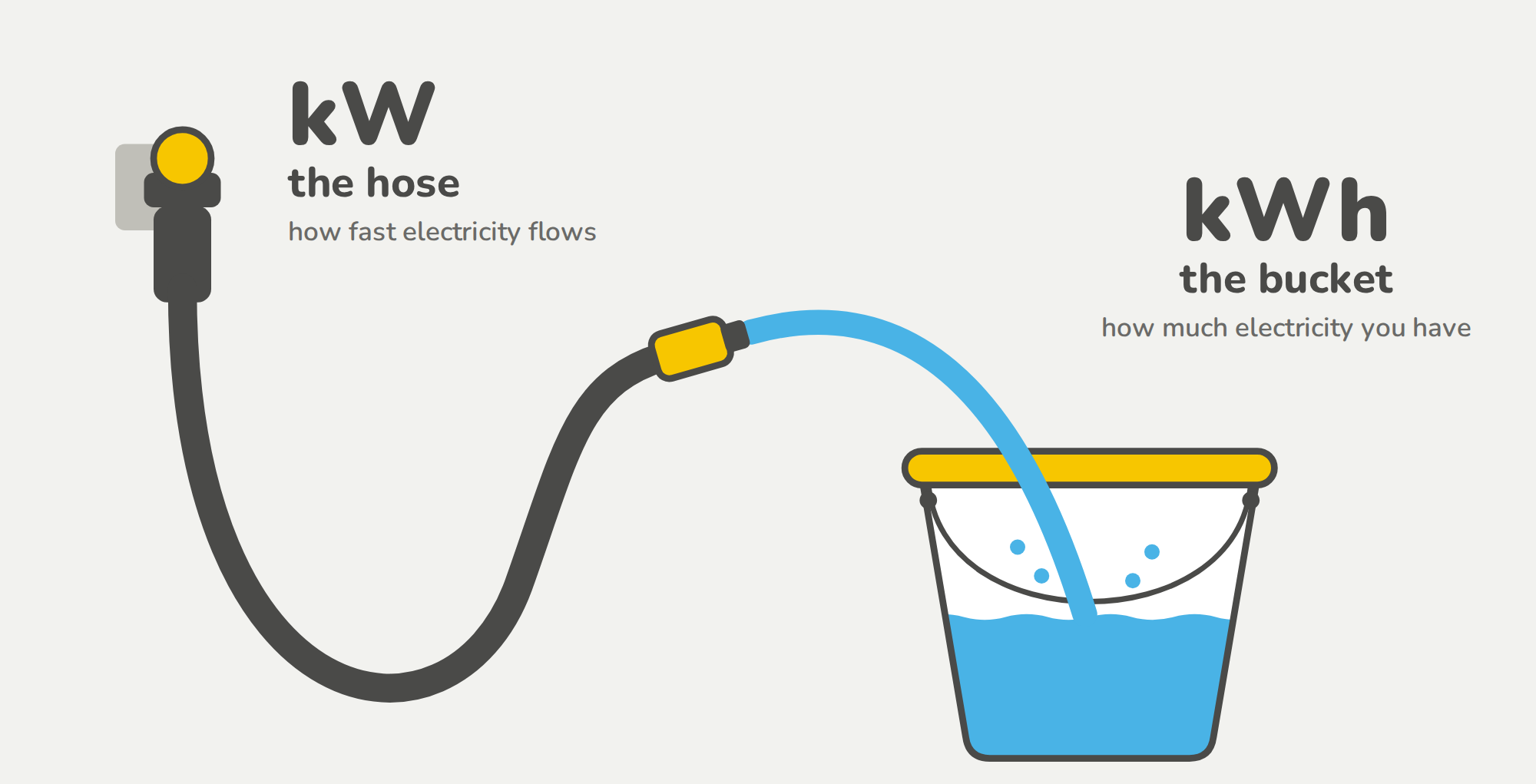
Think of electricity like water
Imagine your EV battery is a bucket. Electricity is the water going into it.
The size of the hose determines how quickly you can fill the bucket.
And the size of the bucket determines how much water it can hold.
In EV charging:
kW = the size of the hose
kWh = the size of the bucket
That's the basic idea behind EV charging.
Once you understand this, it becomes much easier to understand why your EV can take many hours to charge from an ordinary power socket but can add hundreds of kilometres of range during a much shorter stop at a fast charger.
What is a kilowatt (kW)?
A kilowatt (kW) is a measure of power.
One kilowatt is 1,000 watts.
1 kW = 1,000 W
When we're talking about EV charging, the kW number tells us how quickly electricity can be delivered to the car.
Think of it as the size of the hose. A small hose puts water into your bucket relatively slowly. A large hose can fill it much more quickly. The same thing happens with an EV.
A plug-in charger supplying 2.4 kW is delivering electricity at a relatively low rate.
A permanent AC wall charger supplying 7 kW can deliver electricity at a higher rate.
A 100 kW DC fast charger can deliver electricity at a dramatically higher rate.
The bigger the number, the more electrical power is potentially being delivered to the vehicle at any one time.
What is a kilowatt-hour (kWh)?
A kilowatt-hour (kWh) is a measure of energy.
It tells us how much electricity has been stored or used.
Going back to our bucket:
kW is the size of the hose.
kWh is the amount of water in the bucket.
For example, an EV battery might have a capacity of 60 kWh.
That means the battery can store approximately 60 kWh of electrical energy when fully charged, although the amount available to the driver can be somewhat different because EVs generally don't use every last bit of the battery's physical capacity.
A larger EV might have an 80 or even 100 kWh battery.
Think of that as a bigger bucket.
So why does an EV take so long to charge from a normal power socket?
This is where the hose analogy becomes particularly useful.
A standard household power socket can provide a relatively small amount of electrical power compared with an EV fast charger.
A portable EV charging cable might charge at around 2.3 kW from a standard household socket, depending on the equipment and electrical supply.
That's a fairly small hose.
Imagine trying to fill a large bath using a small garden hose.
It will eventually fill.
But it's going to take a while.
The same thing happens when you plug an EV into a normal household socket.
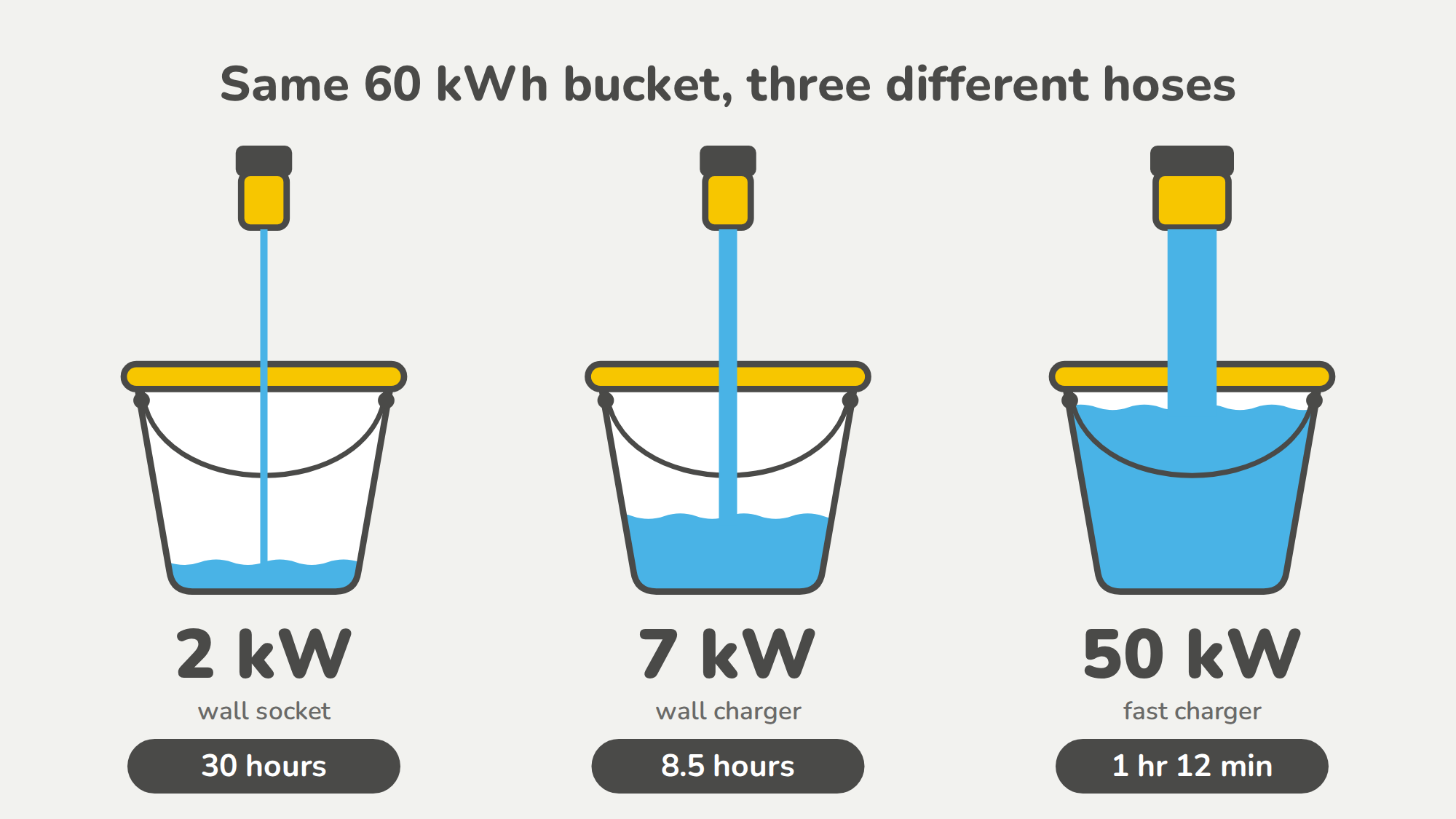
The battery might contain, say, 60 kWh of energy when full.
If you're charging at approximately 2.3 kW, a very simplified calculation would be:
60 kWh ÷ 2.3 kW ≈ 26 hours
That's not an exact real-world charging time because charging involves losses, the battery may not be completely empty, and the charging rate can vary.
But it illustrates the basic problem:
The bucket is large and the hose is small.
A permanent AC wall charger is a much bigger hose
Now imagine a permanent AC wall charger installed by an electrician. These are the kinds of chargers that SolarCharge is designed for and they are capable of around 7 kW (and sometimes up to 22kW).
That's a much bigger hose.
Using the same simplified example:
60 kWh ÷ 7 kW ≈ 8.6 hours
Again, the actual time will vary.
But this explains why a permanent AC wall charger can make such a dramatic difference compared with plugging your EV into an ordinary household socket.
You're not necessarily changing the size of the battery.
You're increasing the rate at which electricity can flow into it.
And because most EVs spend many hours parked, charging whereever you park your car during the day can be enough to replenish a substantial amount of the battery.
Then comes the fast charger
Now imagine replacing that garden hose with a fire hose.
That's roughly the idea behind a DC fast charger.
A public fast charger might be rated at 50 kW or more. Suddenly, electricity can be delivered to the vehicle at a much higher rate.
For example, if an EV could continuously accept 100 kW and needed 50 kWh of energy:
50 kWh ÷ 100 kW = 0.5 hours
That's 30 minutes.
In the real world, however, DC charging isn't quite that simple. But we won’t go into that here. The key point is that DC fast charging, the kind that you stop for while you’re enroute to where you want to go, is a MUCH bigger hose.
The charger isn't the only thing that determines charging speed
You might see a 150 kW DC fast charger and assume that your EV will charge at 150 kW.
It might.
But it might not.
The charging speed is limited by several things.
The most important are:
the maximum power the charger can provide
the maximum charging power the EV can accept
the battery's temperature
the battery's state of charge
the vehicle's charging system
the charging infrastructure and electrical supply
So if you connect an EV that can accept a maximum of 50 kW DC charging to a 150 kW DC fast charger, you're still limited by the car. It's a little like connecting a very large hose to a bucket that has a small inlet.
Making the hose bigger doesn't necessarily make the water enter the bucket faster.
Similarly, permanent AC wall chargers (like those that use SolarCharge) are usually rated either 7 kW or 22 kW. While this is much faster than a plug-in charger, not all EVs can charge at those full rates. Many fully electric EVs have a maximum AC charging of 6.6-11 kW with plug-in hybrid EVs having lower rates - often 3.3-7 kW. It’s helpful to know the maximum charging rates (both AC and DC) of your vehicle - you only have to look it up once!
What about your EV's range?
You can also use kWh to understand EV range.
Imagine your EV has a usable battery capacity of 60 kWh and consumes an average of 15 kWh per 100 km.
In simple terms:
60 ÷ 15 × 100 = 400 km
So the vehicle could theoretically travel around 400 km on that amount of energy.
Real-world range will vary with speed, temperature, terrain, wind, tyres, heating or air conditioning, driving style and other factors.
But the calculation demonstrates the relationship between:
battery size → energy consumption → driving range
A bigger battery is like a bigger bucket.
But a bigger bucket doesn't necessarily mean you'll get more kilometres from every kWh. Efficiency matters too.
The simplest way to think about EV charging
Imagine three ways of filling the same bucket.
🪣 Ordinary power socket
Small hose
Slow flow
Around 2.3 kW
Good for leaving the car plugged in for a long time where no other options are available.
🪣 Permanent AC wall charger
Medium hose
Faster flow
Around 7 kW (sometimes up to 22 kW)
Well suited to charging whenever available where you are parked for prolonged periods of time.
🪣 DC fast charger
Large hose
Very fast flow
50–300+ kW depending on the charger and vehicle
Designed to add a substantial amount of energy during a relatively short stop.
The bucket hasn't necessarily changed.
The difference is how big the hose is and how long you have available to fill it.
And that's the basic idea behind EV charging.
kW is the speed of the hose.
kWh is the amount going into the battery.
Once you understand those two numbers, the rest of the EV charging world starts to make a lot more sense.
